
How to plan a multilingual event: foreign speakers, on-site captions and mobile interpretation listening.
A multilingual event touches speaker languages, audience languages, captions and streaming. This piece provides a complete event-planning checklist, from needs assessment to on-site execution.
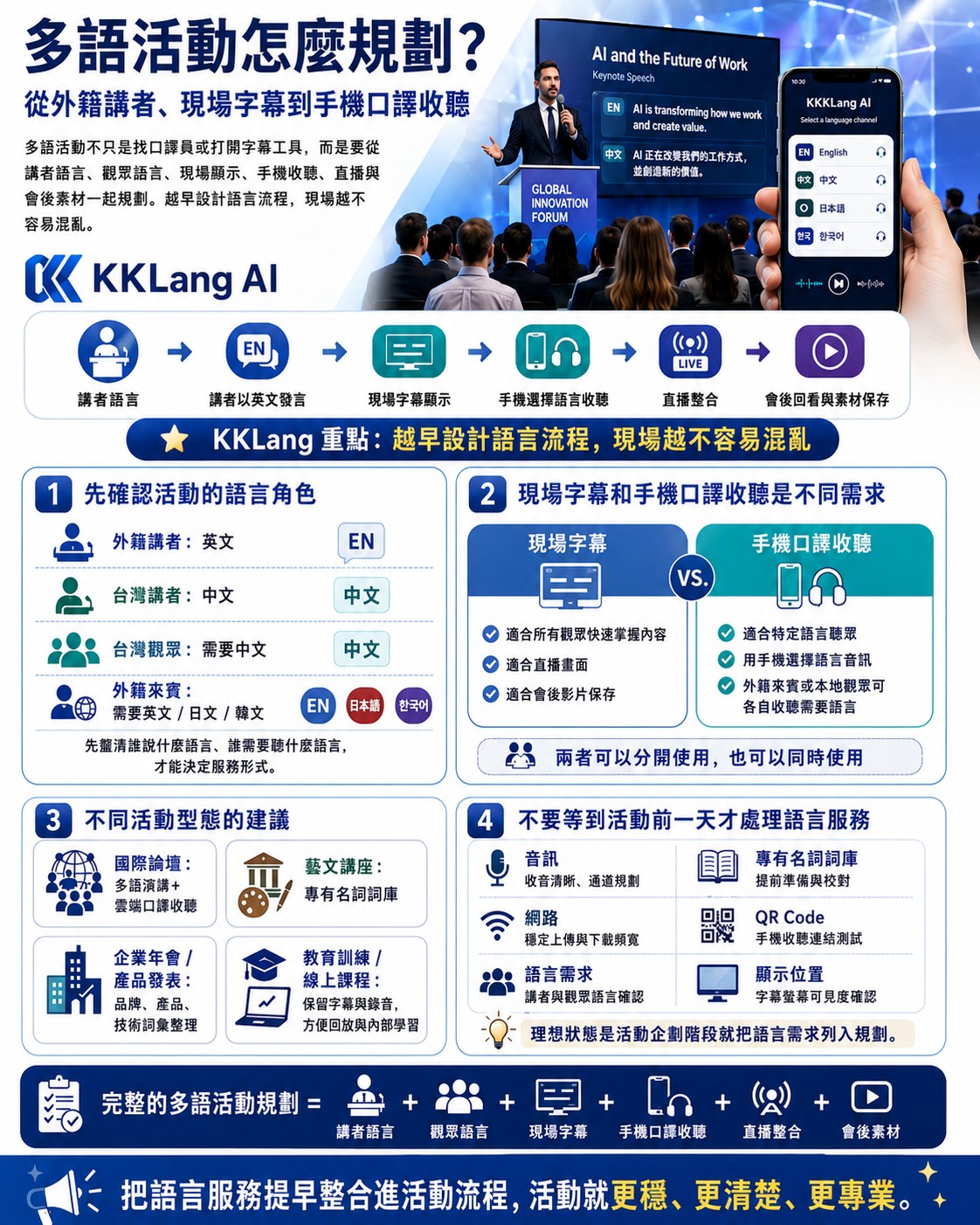
Step one of multilingual event planning: assess your language needs
The starting point of multilingual event planning is not "find an interpreter": it is "clarify your language needs." You need to answer three questions: which speaker languages will appear on site, which listening languages does the audience need, and does the event need streaming and post-event captions? The answers to these three questions drive the interpretation plan, equipment needs and cost structure.
A common misconception is "we have foreign speakers, so we need interpretation." In practice, if a foreign speaker's content is only an opening greeting (5 minutes), a pre-recorded translation may suffice; if it is a keynote (40 minutes), you need full simultaneous interpretation. The "depth" and "length" of the language need directly shape the choice of plan.
Speaker coordination and content preparation
Once language needs are clear, the next step is coordinating with speakers. Contact speakers at least 4 weeks before the event to confirm: the language they will use, the speech outline or slides, the proper nouns and brand names they use, and whether they are willing to share glossary material in advance.
Getting slides and scripts in advance is useful not only for glossary preparation but also lets the AI provider run "pre-training": folding the speaker's wording habits, accent traits and common phrasing into the system to lift recognition accuracy. Even with a human interpretation plan, getting the script in advance helps the interpreter prepare more thoroughly.
Choosing between captions and listening
Multilingual events usually need both "captions" and "voice listening." Captions work well on the on-site big screen, in the stream, or on the attendee's phone page; voice listening suits attendees who need to focus on listening and should not look down at captions (for example walk-through events or roundtables).
The decision tree for choosing a plan: if you only need one primary display language (for example Chinese captions), an AI caption plan is enough; if the audience needs voice listening in multiple languages, choose AI interpretation plus cloud listening; if you need both on-site captions and multilingual listening, run the two in parallel (most AI providers can output both at once).
Streaming and post-event use
If the event will be streamed, integrate the video feed with AI captions (for example YouTube Live's caption feature or an OBS caption plugin). Stream viewers cannot use cloud listening (cloud listening needs the on-site QR Code), but they can see real-time captions on the stream page.
For post-event use, an AI interpretation plan usually provides full recordings (including each language channel) and caption transcripts. These assets can be used for: post-event write-ups, highlight edits, social-media sharing, and building an internal knowledge base. Confirm the delivery format and licensing scope of these assets during event planning.
Complete pre-event checklist
Here is the full planning checklist for a multilingual event. We recommend going through it item by item two weeks before the event:
- Language needs confirmed (speaker languages, audience languages, caption languages, listening languages)
- Speaker slides and glossary collected and delivered to the AI provider
- Venue mixing console confirmed to provide an independent output; cables and connectors ready
- Network bandwidth tested; dedicated Wi-Fi or backup in place
- QR Code display planned (registration, table cards, projection, handout)
- Backup earphones prepared (5% of total headcount)
- Rehearsal time scheduled; test-item list confirmed
- Streaming platform set up; caption integration tested
- Post-event asset delivery format and schedule agreed
Frequently asked questions
How far in advance should a multilingual event be prepared?
We recommend at least 4 weeks. One week for language-needs assessment and plan selection, one week for speaker coordination and glossary collection, one week for venue and equipment confirmation, and the final week for rehearsal and fixes. Compressing to within 2 weeks is doable but raises the quality risk.
What if a foreign VIP is added to give a speech on the day of the event?
The AI plan has the advantage of opening a new language channel on the fly, as long as the VIP's language is within the supported range. We suggest reserving a 10-15% buffer on language channels during planning, or confirming that the provider supports same-day add-ons.
Can stream captions and on-site captions use the same system?
Yes: most AI interpretation systems can output on-site projection captions and stream captions at the same time. The difference is that stream captions need extra encoding and push configuration, so confirm the technical details with the streaming team in advance.