
Are AI captions accurate? Why the proper-noun glossary is the key.
AI caption accuracy depends heavily on pre-event preparation. This piece explains how glossaries, fixed translations and context rules lift quality, and how organizers should prepare.
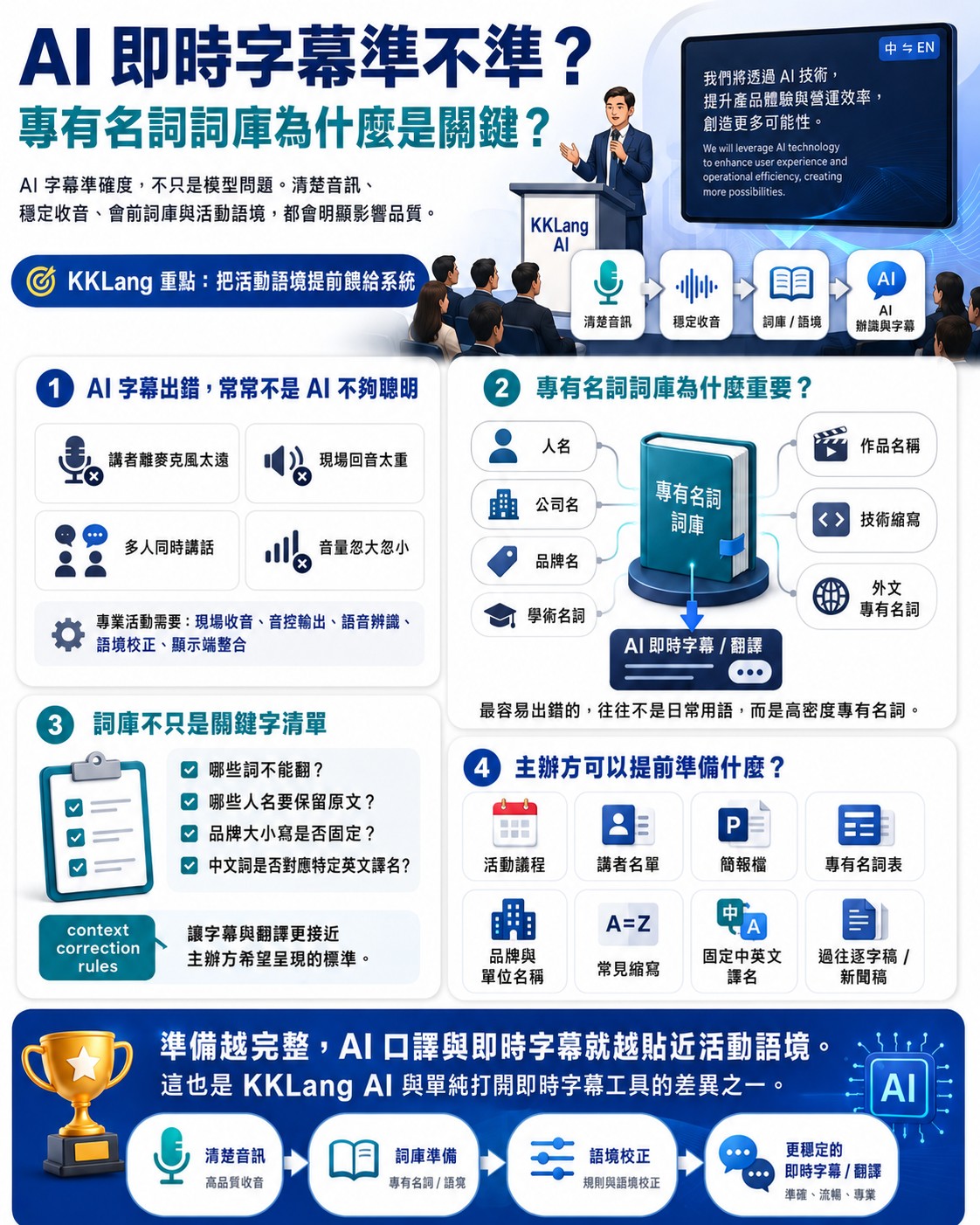
What determines AI caption accuracy
AI caption accuracy is not a fixed number: it is the combined result of several variables. The three biggest factors are on-site audio quality, the speaker's pace and accent, and pre-event glossary preparation. The first two are on-site variables that organizers can only partially control, but glossary preparation is entirely in the organizer's hands, and it is the most effective way to lift accuracy.
In general, without a glossary, AI caption accuracy on generic content runs about 85-90%; on content dense with proper nouns, technical terms and brand names, accuracy can drop to 70-80%. With a glossary in place, recognition accuracy on proper nouns can rise to 95% or higher.
What is an AI interpretation glossary
A glossary is a "proper-noun mapping table" provided to the AI system before the event. It includes speaker names and titles, company names and their official translations, product and brand names, technical terms and abbreviations, and event-specific agenda vocabulary. When the AI recognizes these terms, it prioritizes the glossary translation rather than guessing.
The value of a glossary is "consistency." In a tech forum, the same company name might come up 20 times. Without a glossary, the AI might get it right the first 5 times and wrong the next 15 (or vice versa), confusing the audience. The glossary ensures every occurrence uses the same translation.
How to prepare an effective glossary
Glossary preparation should start 1-2 weeks before the event. First, collect every speaker's slides, the agenda, company profiles and product materials, and extract proper nouns from them. Then confirm the official translation for each term (referencing the company website, press releases, Wikipedia), and flag whether the original form should be kept (some brand names, for instance, are not translated).
We recommend a simple mapping-table format (original term, translation, notes), delivered to the AI service provider 3-5 days before the event for system calibration. A rehearsal test 1 day before the event is also recommended, to confirm the glossary is applied correctly and catch any stragglers.
Context rules and fixed translations
Beyond the glossary, "context rules" also matter. Context rules tell the AI how to translate in a given situation: for example the standard industry rendering of certain technical terms, the formal way to refer to certain brands, or how certain abbreviations should be expanded.
"Fixed translations" address cases where the same concept may have several valid renderings. For example "cloud computing" could be rendered one way or another depending on convention, and so could "machine learning." A fixed translation ensures the whole event uses consistent vocabulary, so the audience does not mistakenly think two different concepts are being discussed.
Frequently asked questions
How many glossary terms are enough?
There is no fixed number, but we recommend at least covering every speaker name, company name, product name and proper noun in the agenda. A typical tech forum glossary runs about 50-200 entries.
Is slide content automatically turned into a glossary?
Not necessarily. Most AI service providers need the organizer to actively provide a glossary list rather than extracting one automatically from slides. We recommend providing slides and glossary separately, and confirming the provider has imported the glossary into the system.
What if a speaker uses a term on the day that is not in the glossary?
The AI will translate it on its own, but accuracy may drop. During rehearsal, try to simulate the actual speech as closely as possible, or ask speakers to share an outline in advance so the glossary can be expanded.