
How does AI interpretation differ from human simultaneous interpretation? Which events suit AI?
AI interpretation is not about replacing humans: it fills the gap where budget and equipment are barriers. This piece compares their strengths, limits and fit, helping organizers choose.
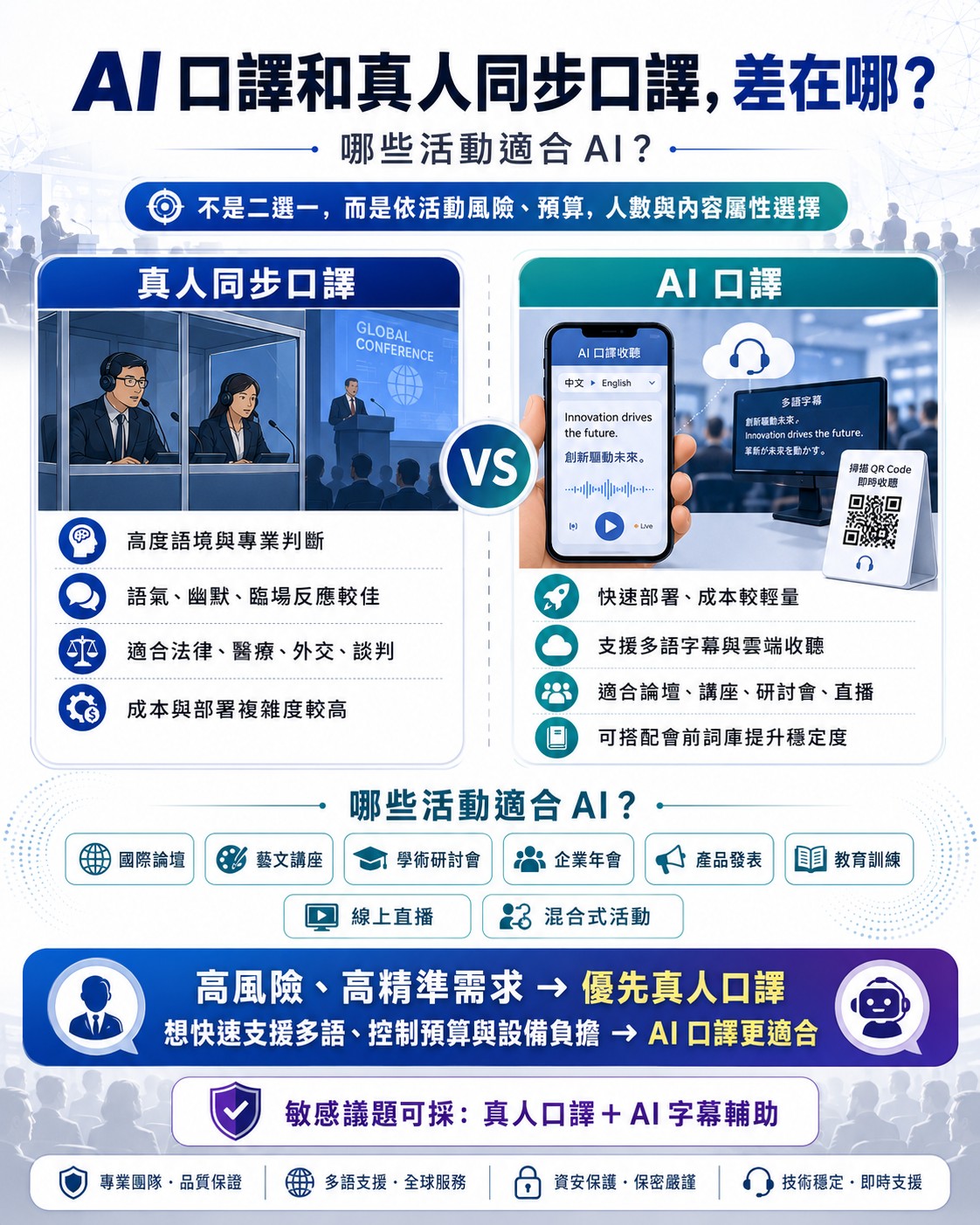
The conclusion first: AI interpretation is not here to replace all human interpretation
In high-stakes settings such as legal, medical, diplomatic and senior business negotiations, professional human interpretation remains irreplaceable. Human interpreters understand cultural context, pick up on tone, handle unexpected situations, and correct mistakes in real time on site.
AI interpretation is positioned for the event types where human interpretation is too expensive or the equipment too heavy: forums, lectures, seminars, corporate annual meetings and training sessions. These events are primarily about delivering information, and AI's real-time output, multilingual support and low barrier let events that previously gave up on interpretation due to budget now offer multilingual service.
The strengths of human simultaneous interpretation
The biggest strength of human interpretation is "understanding." A senior interpreter can predict a full sentence from a fragment of speech, auto-correct when a speaker misspeaks, and choose the most context-appropriate rendering when a term has several valid translations. AI cannot yet do this kind of judgment.
Human interpretation is also far more sensitive to culture and context. Puns, humor, sarcasm and cultural references can be rendered into equivalent expressions in the target language on the fly, whereas AI usually translates them literally and loses the flavor.
Finally, in highly formal or high-risk settings, human interpretation carries the value of accountability: when something goes wrong, a professional can explain and correct it, whereas AI errors often go unnoticed in real time.
The strengths of AI interpretation
The core strengths of AI interpretation are its "cost structure" and "scalability." Once on-site audio is piped in, adding a language channel does not require adding an interpreter, and adding 100 attendees does not require 100 more receivers. This is what makes multilingual service feasible for small and mid-sized events.
AI interpretation is also stable in real time: quality does not drop with interpreter fatigue, and there is no need to rotate two interpreters. For long events such as a full-day forum, AI's steady output can actually be more predictable than staffing.
Third, AI interpretation can output captions and voice simultaneously and archive the entire recording with audio. Achieving the same with human interpretation requires separate recording engineering and post-production.
Which events suit AI interpretation
The event types that suit AI interpretation best include international forums, academic conferences, corporate annual meetings, product launches, training sessions, cultural lectures, and live-streamed or hybrid meetings. Their shared traits: content is primarily informational, the audience is fairly large, language needs are diverse, and the budget must be controlled.
Conversely, legal proceedings, medical consultations, diplomatic negotiations and senior M&A talks should still prioritize human interpretation. In these settings, AI can serve as a captioning aid or backup, but it should not be the only interpretation source.
Frequently asked questions
How accurate can AI interpretation be?
With a pre-event glossary, clean on-site audio and a normal speaking pace, AI caption accuracy typically reaches 90% or higher. But accuracy will fluctuate with accents, terminology density and ambient noise, so a pre-event test is recommended.
Can human interpretation and AI interpretation be used at the same time?
Yes: and this is a common practice at high-end events. Human interpreters handle the primary language pair (for example English to Chinese), while AI handles secondary language pairs or displays captions in sync. The two complement each other to balance quality and cost.
Can AI interpretation handle the Q&A segment?
Yes, but audio quality in Q&A is usually worse (attendees use handheld microphones and stand farther away), so prepare a roving microphone or have staff pass a mic to anyone asking a question, so the AI can recognize the speech clearly.