
Is renting simultaneous-interpretation equipment mandatory? Alternatives for 300-person events.
Traditional simultaneous interpretation needs transmitters, receivers, headsets and engineers. For many events, this hardware is not the only option. This piece compares scan-to-listen, cloud interpretation and other alternatives.
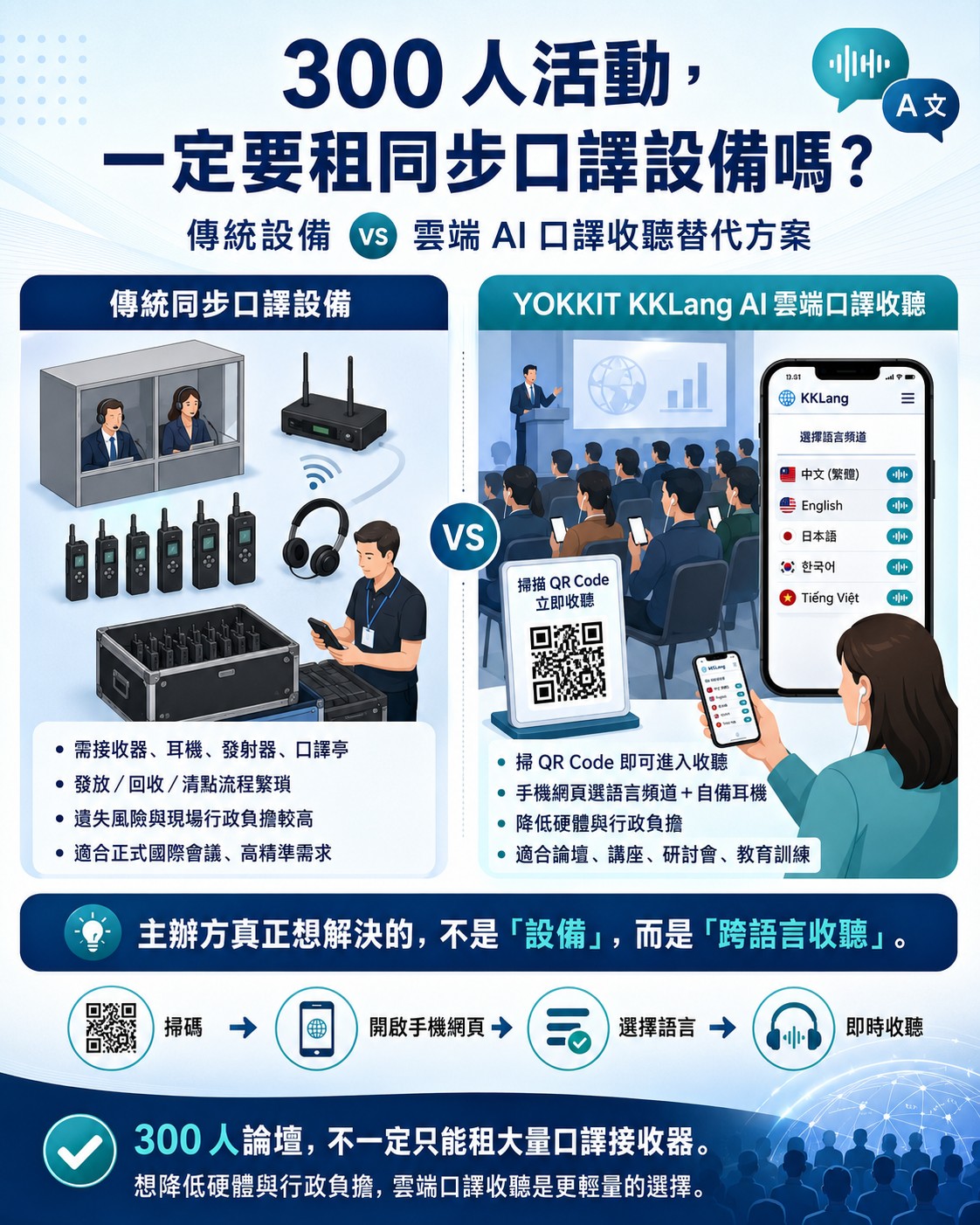
Why organizers are looking for equipment alternatives
For a 300-person international forum, the hardware list for traditional simultaneous interpretation typically includes a transmitter, 300 receivers, 300 headsets, an interpretation booth, cabling and on-site engineers. Renting, shipping, setting up, distributing, collecting and inventorying this equipment eats a large slice of the event's administrative budget and staff time.
The more practical problem is equipment-management risk. Receivers are not cheap to replace, and loss or damage means compensation. Many organizers ask attendees to leave an ID in exchange for a device, which then creates a bottleneck at check-in. For small organizers or associations with limited staff, these hidden costs are often more painful than the interpreter fees themselves.
Common alternatives to traditional interpretation equipment
The alternatives on the market today fall broadly into a few categories:
- Scan-to-listen web app: attendees scan a QR Code, pick a language channel in a browser page, and listen on their own phone and earphones. Representative solution: KKLANG cloud listening.
- Native app listening: attendees must download a specific app. The upside is push notifications and offline caching; the downside is higher adoption friction and a longer install flow.
- FM or infrared receivers: still traditional hardware, so they do not really solve the equipment-management problem, though they offer the lowest audio latency.
- Multi-language audio tracks on a streaming platform: interpretation audio is output as a multi-track live stream. Great for online-only events, but on-site attendees cannot use it.
Why cloud interpretation listening became the mainstream alternative
The core logic of cloud interpretation listening is to convert "equipment distribution" into "web channels." Attendees never pick up physical devices, and organizers never handle collection and inventory. From the attendee's side, listening on their own phone and earphones is more hygienic and convenient than borrowing shared headsets.
Looking at the cost structure, cloud listening is usually tiered by concurrent listeners (for example up to 100, up to 300, up to 1,000). Compared with renting receivers by the unit, this is friendlier to the unit cost of mid-to-large events and easier to keep within budget.
Which events benefit most from switching to an alternative
Events that need to distribute large numbers of receivers (forums, conferences and corporate annual meetings of 300 or more) benefit most directly: you simply skip the rental and management of hundreds of devices. Events with many foreign speakers and scattered audience-language needs are also a good fit, because a cloud solution can carry multiple language channels at once without dedicated hardware for each language pair.
Conversely, if an event involves highly confidential content, forbids any network transmission, or the venue has no stable network at all, traditional hardware may still be the safer choice. We recommend assessing the venue network, audience mix and budget structure during the event planning stage before deciding which approach to use.
Frequently asked questions
Is cloud interpretation listening worse in audio quality than receivers?
On a stable network, cloud listening matches traditional receivers in audio quality, with latency usually under 1 second. The main difference is that cloud solutions depend on the network, so the venue should prepare dedicated Wi-Fi or a wired backup.
What if attendees do not have a phone or earphones?
We suggest organizers prepare a small number of backup earphones (5-10 pairs) for anyone who did not bring their own. As for phones, almost every attendee carries one, but it is still worth confirming at check-in.
How much can a 300-person event save by switching to cloud listening?
Depending on the rental package, the rental, shipping, engineering and inventory cost of 300 receivers typically lands between NT$20,000 and NT$40,000. The add-on price for a 300-person cloud listening plan is about NT$10,000, so the gap is clear.