
What is cloud interpretation listening? A phone-based alternative to receivers.
Attendees scan a QR Code and listen to interpretation on their own phones: no more renting hundreds of receivers. This piece explains how cloud listening works, how to plan capacity, and what to watch for in practice.
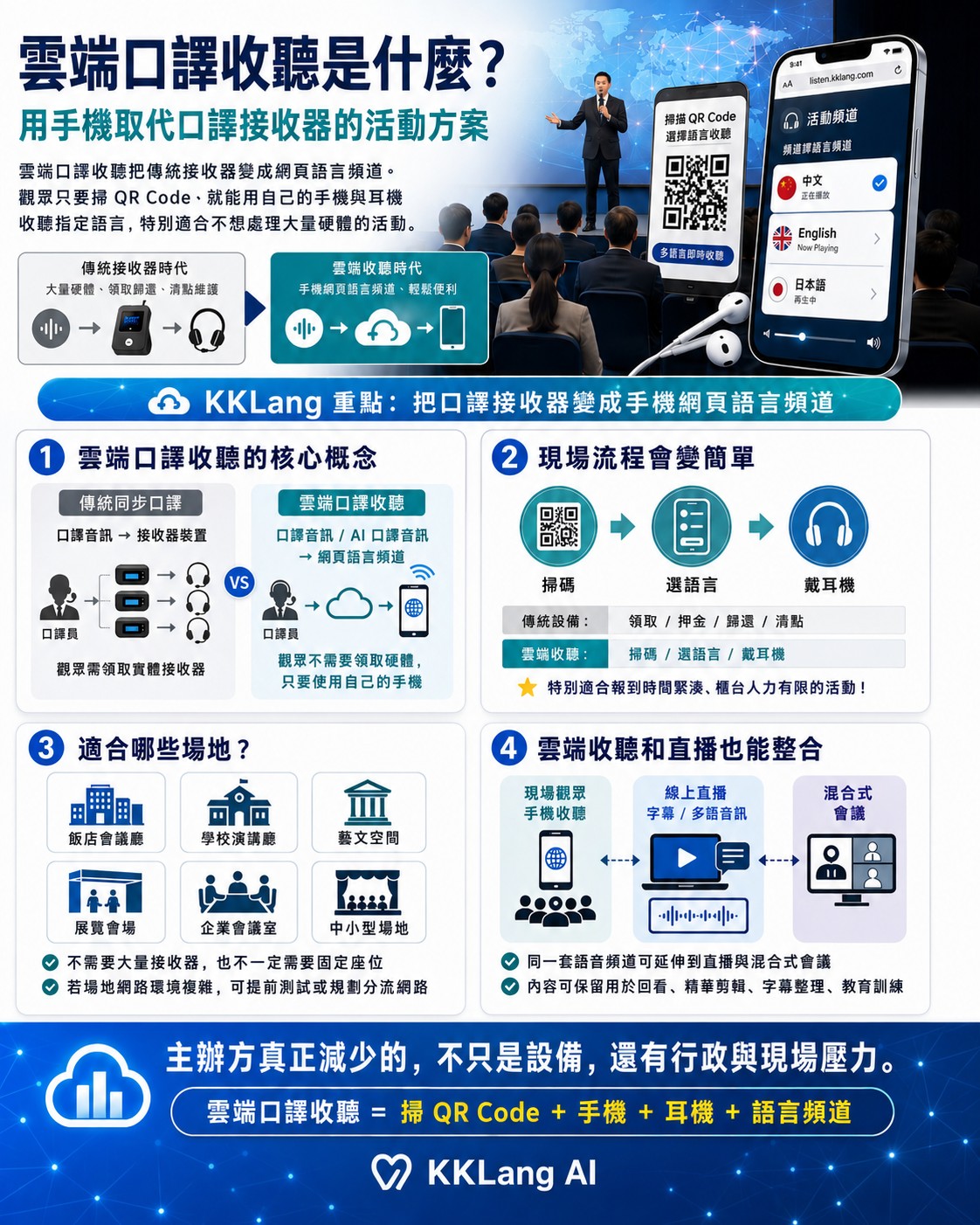
How cloud interpretation listening works
The core architecture of cloud interpretation listening is: on-site audio → AI interpretation server → multilingual voice stream → attendee's phone browser. After an attendee scans the QR Code on site, the phone opens a web page listing the available language channels (Chinese, English, Japanese, Korean and so on). The attendee taps one and listens in real time through their own earphones.
The entire flow needs no app download and no physical device pickup. Attendees just bring their own phone and earphones to use the full service. For the organizer, this removes equipment procurement, rental, shipping, setup, distribution, collection, inventory and loss compensation: every link in the chain.
Cloud listening vs traditional receivers: cost and experience
On cost, traditional receivers rent for about NT$50-100 per unit per day, so a 300-person event already costs NT$15,000-30,000, on top of the transmitter, interpretation booth and engineer. Cloud listening is tiered by concurrent listeners: about NT$5,000 for up to 100, NT$10,000 for up to 300, and NT$20,000 for up to 1,000. The unit cost is lower, and there is no equipment management to handle.
On attendee experience, cloud listening has several advantages: using your own earphones is more hygienic, there is no queue to pick up devices, you can keep listening within network range after leaving the hall, and listening quality is not affected by receiver battery. The main risk is dependence on network stability, so the venue should prepare dedicated Wi-Fi or a wired network.
Capacity planning: how to size the right plan
Cloud listening is priced by "concurrent listeners," not by registrations. We recommend sizing at 80-90% of the expected walk-in headcount, since some registrants will not show up or will not use the service. For example, for an event with 350 registrations, a 300-person plan is usually enough.
If the event has international VIPs or a strongly multilingual audience, leave a 10-15% buffer. When the plan limit is exceeded, the system usually refuses new connections, so some attendees cannot listen: an awkward situation at an international forum that you should definitely avoid.
Network and on-site preparation
The most critical on-site condition for cloud listening is the network. Each listener needs about 100-200 Kbps of bandwidth, so 300 simultaneous listeners need 30-60 Mbps of stable upload bandwidth. Most mid-sized venue Wi-Fi gets visibly congested when 300 people connect at once, so prepare dedicated Wi-Fi or evaluate a 4G/5G backup.
Next is where to display the QR Code. Show it at the registration desk, the hall entrance, every table card, a fixed corner of the projection, and in the event handout, and have the host prompt attendees to scan before the event starts. If attendees scan only after the event is underway, they will miss the opening content.
Frequently asked questions
What is the typical latency of cloud listening?
On a stable network, the delay from a speaker's voice to interpretation reaching an attendee's earphones is usually 1-3 seconds. For forums and lectures this delay is barely noticeable; if you are extremely latency-sensitive (for example a synchronized performance), use a traditional hardware plan instead.
Can attendees keep listening after leaving the hall?
Yes: as long as the attendee's phone has a network connection (mobile data or Wi-Fi outside the hall), they can keep listening after stepping out. This is very convenient for VIPs or staff who need to leave mid-event.
What if the venue has no stable Wi-Fi?
We recommend renting mobile network equipment (such as a 4G/5G router) as backup, or asking a telecom carrier to set up a temporary cell site. Many AI interpretation providers can also offer a network assessment and backup plan.