
Case study: a 300-person tech forum’s decision journey with AI interpretation.
How one tech-forum organizer balanced budget against quality, chose AI interpretation with cloud listening, and actually improved attendee satisfaction.
Event background: why the interpretation plan needed a fresh look
In spring 2026, a technology industry association held its annual international forum, covering AI, cloud computing and semiconductor trends. The event had about 300 attendees, including two foreign keynote speakers (one English, one Japanese), six local speakers (Chinese), and a roundtable panel. The event ran for a half-day (4 hours), with the on-site session streamed live on YouTube in parallel.
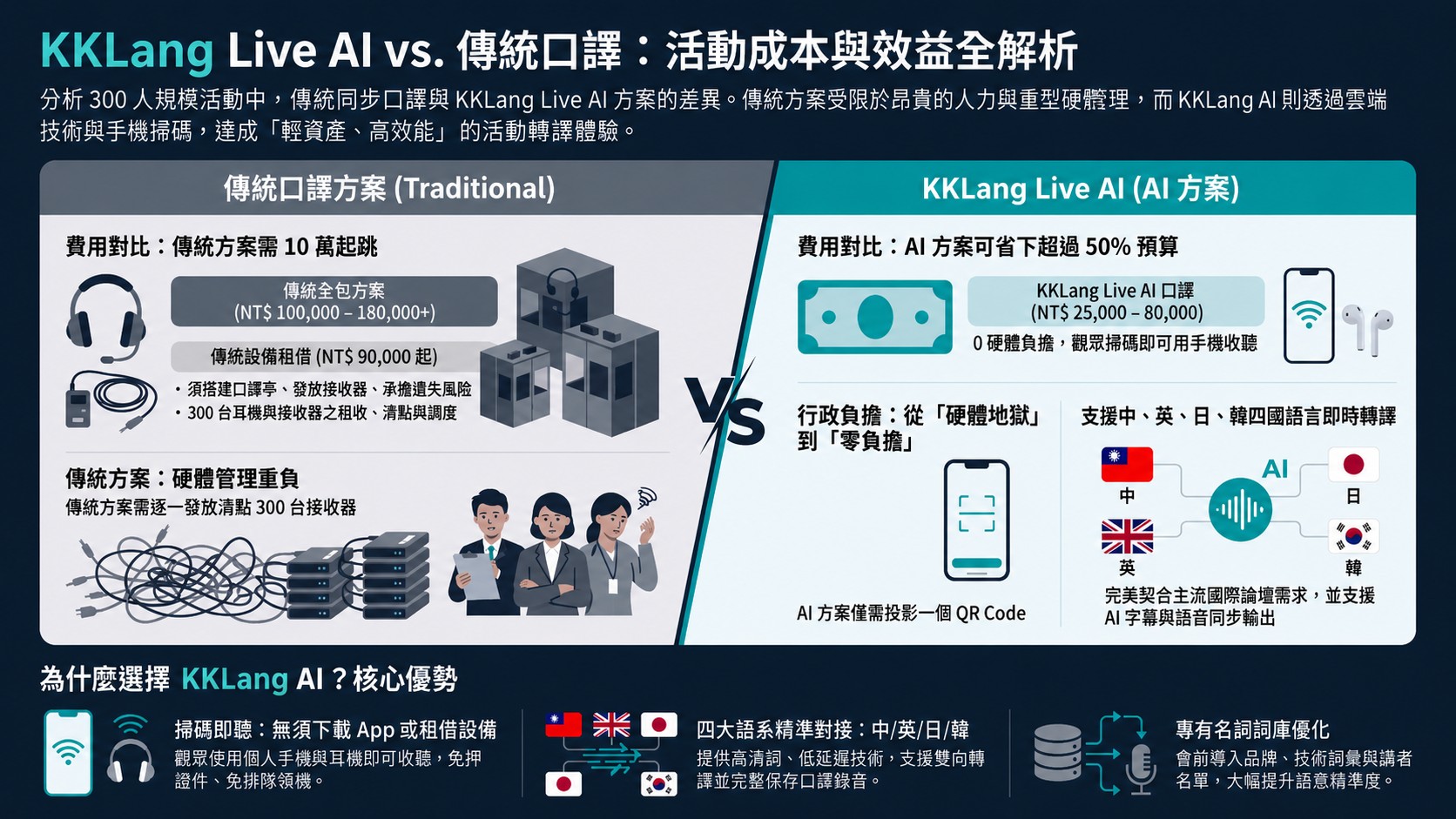
For the previous three years the organizer had used traditional human simultaneous interpretation: two Chinese-English interpreters, 300 receivers and on-site engineers, at a total cost of about NT$75,000-90,000. But budgets had tightened, and Secretary-General Lin was asked to cut the interpretation budget by more than 30% without sacrificing the attendee experience.
"We were not cutting cost for the sake of cutting cost," Director Lin explained in the interview. "We wanted to redirect what we saved into more high-profile speaker invitations and content production. Interpretation is essential, but the cost structure of the traditional plan was becoming heavier and heavier for a mid-sized association."
Evaluating options: comparing three plans
The organizer compared three plans. Plan A kept traditional human interpretation (about NT$85,000, lowest risk). Plan B switched to AI interpretation plus cloud listening (about NT$45,000, but with concerns about AI quality). Plan C was a hybrid: human interpretation for the keynotes and AI for the rest (about NT$55,000).
Cost was not the only thing weighed during evaluation. Director Lin cared especially about three things: whether the foreign speakers' technical terms would be translated accurately, whether the on-site listening experience would be smooth, and whether online viewers would see real-time captions. The traditional plan was reliable on the first two but needed extra work for stream captions. The AI plan had a natural edge on stream captions but needed validation on the first two.
"We asked KKLANG for case-study demos from past forums," Director Lin recalled. "After listening to the Japanese-to-Chinese interpretation audio, we had basic confidence in the AI quality. But what really won us over was the pre-event glossary preparation: they asked us to provide every speaker's slides, company names and product names in advance, and committed to system calibration. That made us feel the AI was not 'random translation' but 'customized translation.'"
Decision: the key reasons for choosing Plan B
The organizer ultimately chose Plan B (pure AI interpretation plus cloud listening), for three main reasons. First, the cost saving was significant (NT$85,000 → NT$45,000, down 47%), and the freed-up budget went toward inviting a more high-profile keynote speaker. Second, the AI plan could simultaneously output Chinese, English and Japanese captions and voice, whereas the traditional plan would have needed three interpreters and multi-channel equipment to do the same: pushing the cost past NT$150,000. Third, online viewers could see captions in real time, while the traditional plan would have needed extra integration for stream captions, with higher technical risk.
"Honestly, we were also worried at first that the AI might fail at a critical moment," Director Lin admitted. "But KKLANG suggested keeping one human interpreter as backup for the keynote segment, at an added cost of only NT$15,000. That 'insurance policy' made it much easier for our board to accept the AI plan."
Execution: pre-event preparation and on-site reality
Three weeks before the event, the organizer delivered a complete glossary list (about 120 entries, covering speaker names, company names, product names and technical terms). One week out, KKLANG completed system calibration and provided test audio for the organizer to confirm. Two days out, the team ran a full rehearsal at the venue, testing the mixing console's independent output, network bandwidth (the 300-person plan required at least 60 Mbps), and QR Code scan success rate.
On the day, on-site attendees scanned the QR Code on the table cards to enter the listening page and pick a Chinese, English or Japanese channel. Cloud listening ran stably for the entire event, peaking at 247 concurrent listeners (under the 300-person cap). The stream channel showed Chinese captions in sync, and online viewers reported caption latency of about 3 seconds, within an acceptable range.
"What surprised me most was the usage rate," Director Lin said. "In the past, with traditional receivers, only about 60% of attendees actually picked them up, because collecting a device meant queuing and leaving an ID. This time, scan-to-listen usage hit 82%, and the post-event survey showed attendee satisfaction with interpretation quality was actually higher than last year."
Outcomes: quantitative data and qualitative feedback
After the event, the organizer compiled the quantitative results: total cost fell from NT$85,000 to NT$45,000 (including the NT$15,000 human-interpreter backup), down 47%; attendee usage of interpretation rose from 60% to 82%; post-event satisfaction rose from 3.8 to 4.3 (out of 5); and stream watch time was up 35% year-on-year (attributed to captions lifting watch-through).
On the qualitative side, several foreign participants specifically noted: "In the past at Taiwanese forums, if I could not follow I would just give up; this time, with English captions, I could keep up with the entire agenda." Local attendees also said: "The Japanese speaker's content became much clearer through the Chinese captions: before, the interpreter's voice was hard to make out over the room echo."
Director Lin summed it up: "For us, AI interpretation is not a 'second-best choice': given our budget and needs, it is the 'more suitable choice.' We will use it again next year, and consider putting the saved budget into adding Japanese and Korean language channels, so the forum can truly become a regional exchange platform for Asia."
Advice from the organizer to peers
At the end of the interview, Director Lin shared three pieces of advice for peers evaluating AI interpretation. First, "do not just compare quotes": the quality of an AI plan depends heavily on pre-event preparation, so choosing a provider willing to invest in glossary calibration and rehearsal matters more than picking the cheapest.
Second, "keep human interpretation as backup for critical segments": even under an AI plan, spending an extra 15-20% of budget to retain a human interpreter for high-risk segments such as keynotes or signing ceremonies dramatically lowers risk and makes the decision easier to accept internally.
Third, "fold stream captions into the overall plan": one of the biggest advantages of an AI plan is that captions and voice come out together. Treating AI only as a drop-in replacement for traditional interpretation and ignoring stream integration wastes its value.
Frequently asked questions
Our event is a different size: does this case study still apply?
The decision logic in this case (budget assessment, plan comparison, pre-event preparation, backup planning) applies to all kinds of multilingual events of 100-500 people. Actual costs and results will vary with event size, number of languages and venue conditions, so we recommend reaching out for a customized assessment.
How do we contact KKLANG to assess our event?
Fill out our contact form with the event date, venue, estimated headcount, speaker languages and the listening languages your audience needs. We will reply within 2 business days with a preliminary assessment and a recommended plan.